
A Presidência ainda é imaginada no masculino.
Por Valéria Monteiro.
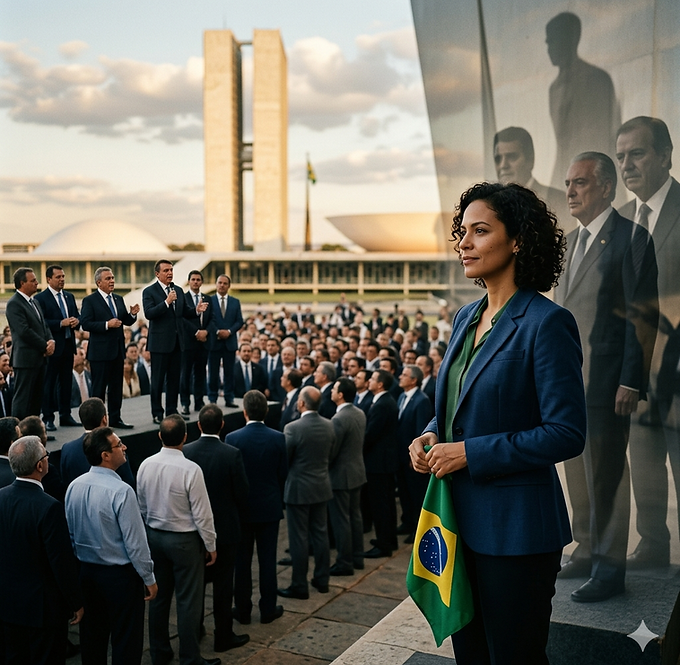
O problema não é apenas quantas mulheres aparecem na disputa, mas o que a dificuldade de normalizá-las
no centro do poder revela sobre a imaginação política brasileira.
🇺🇸 (Scroll Down For English)
Em ano eleitoral, o Brasil volta a fazer uma coisa que conhece bem: reorganizar o futuro em torno de nomes
masculinos como se isso fosse apenas um dado objetivo — e não também o sintoma de um hábito profundo.
As alianças se movem, os cálculos se rearranjam, o ruído cresce.
E quase tudo retorna, com excessiva naturalidade, ao mesmo eixo de autoridade. O que impressiona não é apenas a escassez de mulheres no centro competitivo da disputa presidencial. É a serenidade com que essa escassez continua sendo absorvida.
Como se fosse normal. Como se fosse inevitável. Como se fosse simplesmente — a realidade. Não é.
O problema não é só numérico. Não se trata de contar quantas mulheres aparecem, quantas são cogitadas, quantas sobrevivem à periferia simbólica do debate. O ponto é mais fundo: continua sendo difícil, no Brasil, imaginar uma mulher como centro natural do poder. Essa dificuldade diz muito sobre o país — e sobre os limites daquilo que ele consegue reconhecer como normal.
O Brasil aceita mulheres na política. Aceita mulheres influentes, visíveis, vocais, eleitoralmente úteis. Aceita mulheres como composição, como exceção admirável, como equilíbrio simbólico ou de chapa. O que continua menos naturalizado é a hipótese mais substantiva: uma mulher não como adição, não como concessão retórica à modernidade, mas como expressão quase óbvia de comando.
É nesse ponto que a discussão deixa de ser apenas sobre representação e se torna estrutural. Porque a pergunta relevante não é só por que há poucas mulheres no centro da disputa. A pergunta mais reveladora é outra: por que, mesmo quando elas existem, ainda parecem menos intuitivas como lugar do poder?
O Brasil já teve uma mulher presidente. E, ainda assim, mulher no centro do comando continua parecendo exceção.
Esse dado, por si só, já deveria produzir desconforto analítico.
Presidentes homens também decepcionaram o país — às vezes de forma medíocre, às vezes grave, às vezes historicamente devastadora. Nem por isso o masculino deixou de ser percebido como a linguagem espontânea do poder. As falhas dos homens são processadas, via de regra, como falhas individuais, partidárias, conjunturais. Raramente contaminam o masculino como categoria de autoridade.
Quando uma mulher chega ao topo e se torna controversa, a controvérsia parece irradiar além da pessoa. Como se ela representasse não apenas a si mesma, mas a viabilidade do próprio comando feminino. É uma das assimetrias mais silenciosas — e mais reveladoras — da política brasileira.
Ouvi essa lógica formulada com clareza em 2018, durante a Caravana da Coragem. Diziam: depois da Dilma, não será fácil ter outra mulher presidente. A frase vinha vestida de pragmatismo. No fundo, porém, embutia outra coisa: a ideia de que a passagem de uma mulher pelo Planalto teria deixado um saldo simbólico mais comprometedor do que a longa sucessão de fracassos protagonizada por homens na Presidência.
Como se homens pudessem falhar sem abalar a naturalidade do seu lugar no poder — enquanto mulheres, ao falharem ou ao serem julgadas como tendo falhado, reabrissem a suspeita sobre a legitimidade da sua presença ali.
É uma régua desigual. E talvez uma das mais persistentes da nossa cultura política.
Por isso essa conversa não pode ser reduzida a uma pauta decorativa de representação. O ponto não é apenas presença. É legitimação. É o que o país reconhece, de forma quase instintiva, como autoridade plena.
E, nesse repertório, a Presidência ainda é muitas vezes intuída no masculino. Não apenas pelos partidos e suas engrenagens de poder formal. Mas também pela cobertura política, pela linguagem pública, pelo hábito do eleitorado — e por uma pedagogia silenciosa da autoridade que, ao longo de décadas, ensinou o Brasil a reconhecer comando sobretudo em vozes, gestos e corpos masculinos.
O poder não se impõe apenas por instituições. Ele se sedimenta por familiaridade. E o que parece familiar demais costuma passar por natural.
Nomear esse padrão não é amargura. É diagnóstico. E diagnósticos honestos são, precisamente, o ponto de partida de qualquer reconstrução séria.
Um país que ainda trata a mulher no centro da Presidência como exceção tolerável — e não como possibilidade intuitiva — não está dizendo nada sobre a capacidade das mulheres. Está dizendo algo sobre a estreiteza da sua própria imaginação de poder. E imaginação estreita não constrói futuro. Apenas
administra o passado com outras roupagens.
Democracias não revelam apenas preferências.
Revelam os limites do que são capazes de
reconhecer como normal.
A eleição de 2026 ainda não revelou tudo o que será. Mas uma coisa ela já deixa ver com clareza desconfortável: mesmo depois de uma mulher ter ocupado o Planalto, ainda é raro que uma mulher apareça, no imaginário nacional, como o lugar mais natural do comando.
Isso não é realidade neutra. É um retrato. E retratos — diferente do que às vezes se supõe — não são destino.
Este texto faz parte de uma conversa mais longa sobre o Brasil que ainda precisamos ser capazes de imaginar — e construir.
🇺🇸Inglês:
In an election year, Brazil returns to something it knows well: reorganizing the future around male names as though that were simply an objective fact — rather than the symptom of a habit so old it has learned to disguise itself as nature.
Alliances shift, calculations are rearranged, the noise grows louder. And nearly everything drifts back, with striking ease, toward the same axis of authority. What is remarkable is not only the scarcity of women at the competitive center of the presidential race. It is the calm with which that scarcity continues to be absorbed. As though it were normal. As though it were inevitable. As though it were simply — how things are.
It is not.
The problem is not merely numerical. It is not a matter of counting how many women appear, how many are mentioned, how many survive the symbolic outskirts of the debate. The point is deeper: in Brazil, it remains genuinely difficult to imagine a woman as the natural center of power. That difficulty says something important — about the country, and about the limits of what it is able to recognize as normal.
Brazil accepts women in politics. It accepts influential women, visible women, outspoken women, electorally useful women. It accepts women as additions, admirable exceptions, symbolic balance, balance on a ticket. What remains far less normalized is the more substantive possibility: a woman not as an add-on, not as a rhetorical concession to modernity, but as the nearly self-evident embodiment of command.
That is the point at which the discussion stops being about representation and becomes structural. Because the important question is not only why so few women appear at the center of the race. The more revealing question is a different one: why, even when they do exist, do they still feel less intuitive as the place of power?
Brazil has already had a woman president. And even so, a woman at the center of command still registers as an exception.
That fact alone should produce some analytical discomfort.
Male presidents have disappointed the country as well — sometimes in mediocre fashion, sometimes gravely, sometimes in ways that were historically devastating. Yet maleness itself never ceased to be perceived as the spontaneous language of power. Men's failures are generally processed as individual, partisan, or circumstantial failures. They rarely contaminate maleness as a category of authority.
When a woman reaches the top and becomes controversial, however, the controversy seems to radiate beyond the individual. As though she were taken to represent not only herself, but the very viability of female command. This is one of the quietest — and most revealing — asymmetries in Brazilian politics.
I heard it expressed with particular clarity in 2018, during the Caravana da Coragem. People would say: after Dilma, it will not be easy to have another woman president. The sentence came dressed as pragmatic realism — a hard but mature reading of the country. But beneath it lay something else: the idea that one woman's passage through the Planalto had left a more damaging symbolic residue than the long succession of failures, crises, and disorders produced by men in the presidency.
As though men could fail without disturbing the naturalness of their place in power — while women, when they fail, or are judged to have failed, reopen suspicion about whether they belonged there at all.
It is an unequal measure. And perhaps one of the most persistent in Brazil's political culture.
That is why this conversation cannot be reduced to a decorative question of representation. The point is not only presence. It is legitimacy. It is what the country recognizes, almost instinctively, as full authority.
And within that repertoire, the presidency is still often intuited as male. Not only by parties and their formal power structures. But also by political coverage, public language, voter habit — and by a quiet pedagogy of authority that, over decades, trained Brazil to recognize command above all in male voices, gestures, and bodies.
Power is not imposed only through institutions. It is sedimented through familiarity. And what feels familiar enough tends to pass as natural.
To name this pattern is not bitterness. It is diagnosis. And honest diagnoses are precisely where any serious reconstruction begins.
A country that still treats a woman at the center of the presidency as a tolerable exception — rather than as an intuitive possibility — is saying nothing about women's capacity. It is saying something about the narrowness of its own imagination of power. And a narrow imagination does not build the future. It only administers the past in different clothing.
Democracies reveal more than preferences. They reveal the limits of what they are able to recognize as normal.
The 2026 election is still far from revealing everything it will become. But one thing it already makes visible, with uncomfortable clarity: even after a woman has occupied the Planalto, it remains rare for a woman to appear, in the national imagination, as the most natural place of command.
That is not neutral reality. It is a portrait. And portraits — unlike what is sometimes assumed — are not destiny.
This piece is part of a longer conversation about the Brazil we still need to be able to imagine — and to build.

Valéria Monteiro.
Jornalista, fundadora do site valeriamonteiro.com.br
e ex-âncora da TV Globo e Bloomberg.
10/04/26

Leia também
Bastilha em Manhattan.
Por Valéria Monteiro.
